Sam Jaffe: Age, Wife, Net Worth, Films and Life
Sam Jaffe: Age, Wife, Net Worth, Films and Life
Sam Jaffe was one of those actors whose face you knew even if his name escaped you. He played Gunga Din in 1939, Doc in The Asphalt Jungle in 1950, Professor Barnhardt in The Day the Earth Stood Still in 1951, and Simonides in Ben-Hur in 1959. On television he was Dr. David Zorba on Ben Casey. He was also a maths teacher, a Broadway actor, and a man who lost years of work to the Hollywood blacklist. He died in 1984, at 93.
Sam Jaffe at a Glance
- Full name: Shalom Jaffe
- Born: March 10, 1891, in New York City, USA
- Died: March 24, 1984, in Beverly Hills, California, aged 93
- Work: Actor, teacher, musician and engineer, active 1915–1984
- Famous as: Gunga Din; Doc Riedenschneider in The Asphalt Jungle; Professor Barnhardt in The Day the Earth Stood Still; Simonides in Ben-Hur; Dr. David Zorba on Ben Casey
- Awards: Volpi Cup for Best Actor, Venice (1950); Oscar nomination for Best Supporting Actor (1951); Emmy nomination (1962); Paul Robeson Award (1978)
- Wives: Lillian Taiz (1926–1941); Bettye Ackerman (1956–1984)
- Children: None
Who Was Sam Jaffe?
Sam Jaffe was an American character actor whose career ran for almost 70 years, from the Yiddish stage of New York to Broadway, Hollywood and television. He was never a leading man in the usual sense: short, with a shock of curly hair and a face made for odd, clever parts.
Born Shalom Jaffe, he kept the first name Sam for the stage. Before acting paid his bills he taught mathematics, having graduated in engineering from the City College of New York in 1912 and studied at Columbia. He was 24 when he went back to the stage for good, and 43 when he made his first film, and his best-known film parts all came after he turned 45.
A Maths Teacher from the Lower East Side
Jaffe was born on March 10, 1891, at 97 Orchard Street on the Lower East Side of New York City, a building that now holds the Lower East Side Tenement Museum. His parents, Heida (Ada) and Barnett Jaffe, were Ukrainian Jewish immigrants; his father was a jeweller, and his mother had been a Yiddish actress in Odesa before the family moved to America, where she became a well-known actress and vaudeville star.
The youngest of four children — older brother Abraham, older sisters Sophie and Annie — he appeared as a boy in Yiddish theatre productions with his mother. He went to Townsend Harris High School, then studied engineering at the City College of New York, graduating in 1912, followed by graduate studies at Columbia University.
For several years he taught mathematics at the Bronx Cultural Institute, a college preparatory school, and became its dean of mathematics. Acting was still in his blood, and in 1915 he left teaching and joined the Washington Square Players, a New York theatre group. He was 24, and he would act for the next 69 years.
Most sources give his birth date as March 10, 1891, the date used here; the Jewish Virtual Library gives March 8, and Wikidata also lists March 10, 1893, a date with no support in the main biographies.
The Broadway Years
Jaffe made his Broadway debut in 1918 in Youth, and over the next six decades he appeared in 21 Broadway plays, the last in 1979, when he was 88.
In 1923 he appeared in the Broadway premiere of God of Vengeance by Sholem Asch, playing Reb Ali, in a production that became notorious after the cast was charged with indecency. His other Broadway credits included Grand Hotel (1930–31), The Eternal Road (1937), A Doll’s House (1937–38), Cafe Crown (1942) and Mademoiselle Colombe (1954).
As a young man he lived in Greenwich Village in the same apartment building as a young John Huston. The two became close friends for life, and Jaffe later starred in two of Huston’s films, The Asphalt Jungle and The Barbarian and the Geisha. His friends included the actor Edward G. Robinson, the comedian Zero Mostel, the writer Ray Bradbury and the composer Igor Stravinsky. His biography also credits him with helping to create the Equity Library Theatre, a project that gave stage work to hundreds of actors.
Hollywood Breakthrough: The Scarlet Empress and Lost Horizon
Jaffe began working in film in 1934, at 43. His first role was the mad Tsar Peter III in The Scarlet Empress, directed by Josef von Sternberg and starring Marlene Dietrich — a frightening, twitchy performance that Hollywood noticed at once.
Three years later Frank Capra cast him as the High Lama in Lost Horizon (1937), the mysterious holy man of Shangri-La, a part he got at the last minute after the actor first cast had died. The film was a hit, and the High Lama became one of his signature parts — a calm, wise old man with a secret.
Gunga Din: The Role That Made Him Famous
Gunga Din (1939), directed by George Stevens, starred Cary Grant, Victor McLaglen and Douglas Fairbanks Jr. as three British soldiers in colonial India. Jaffe played the title role: Gunga Din, the regimental water carrier, a bhisti, who dreams of becoming a soldier himself.
It was unusual casting — a New York stage actor given the lead part of an Indian water carrier — but he played it with warmth and dignity, and the film was a huge hit. In the final scene he sounds the bugle to warn the regiment and dies a hero, and Kipling’s line — “You’re a better man than I am, Gunga Din” — became part of the language.
The part made Jaffe’s name, and set a pattern: he would be cast as the wise outsider, the man who sees what others miss.
The Asphalt Jungle and the Oscar Nomination
He made no film for eight years after Gunga Din. His next notable film was Elia Kazan’s Gentleman’s Agreement (1947), about anti-Semitism, in which he played an Einstein-like professor, and doctor parts followed.
Then, in 1950, John Huston gave him the part of his life: Erwin “Doc” Riedenschneider in The Asphalt Jungle, a criminal mastermind fresh out of prison who plans a jewel robbery down to the last detail. Jaffe played him with a coiled, precise intelligence that held the whole film together.
The performance won him the Volpi Cup for Best Actor at Venice in 1950, and in 1951 he was nominated for the Academy Award for Best Supporting Actor. He did not win — George Sanders won for All About Eve — but the nomination, at 59, was the high point of his film career.
The Day the Earth Stood Still
In 1951 Jaffe made three films, and one of them became a science-fiction classic. In Robert Wise’s The Day the Earth Stood Still, he played Professor Jacob Barnhardt, the Einstein-like scientist who is the only human able to understand the alien visitor Klaatu, played by Michael Rennie.
Barnhardt is a small part, but he is the moral centre of the film: he listens to Klaatu, takes him seriously, and helps him reach the world’s scientists. Fittingly, Jaffe the trained mathematician is said to have supplied the equations on Barnhardt’s blackboard himself.
It was also the film that marked the start of his hardest years.
The Blacklist Years
In the early 1950s, at the height of the anti-communist panic in America, Jaffe’s name appeared in Red Channels, a pamphlet listing performers said to be sympathetic to communism. There was no trial and no proof, but the listing was enough, and the big Hollywood studios stopped hiring him.
He was blacklisted through most of the 1950s, made no screen appearance for about seven years after 1951, and went back to the stage to wait.
Two directors stood by him. Robert Wise had already hired him for The Day the Earth Stood Still, backed by producer Julian Blaustein and studio head Darryl F. Zanuck. In 1958 his old friend John Huston cast him in The Barbarian and the Geisha, with John Wayne, and a year later William Wyler cast him as Simonides, the loyal old servant, in Ben-Hur (1959), the biggest film of its time. Ben-Hur won 11 Academy Awards, and Jaffe was back in major films.
The blacklist had cost him seven years at the peak of his fame, between 60 and 67, and the gap in his filmography tells the story plainly.
Dr. Zorba and Ben Casey
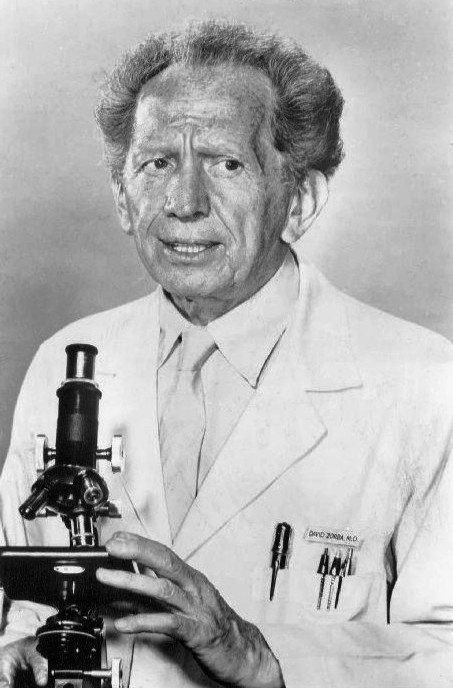
In 1961, at 70, Jaffe found the role that made him a household name on television: Dr. David Zorba, chief of neurosurgery on the ABC medical drama Ben Casey, a wise, firm and kind old doctor who mentored the hot-headed young Dr. Casey, played by Vince Edwards.
Zorba was the voice of reason on the show, the man who had seen everything and stayed calm. Jaffe played him for four seasons, from 1961 to 1965, and in 1962 he was nominated for a Primetime Emmy Award. His wife, Bettye Ackerman, also appeared on the show, as Dr. Maggie Graham.
The part suited him perfectly, and for a generation of television viewers, Sam Jaffe simply was Dr. Zorba.
Later Work and Final Years
After Ben Casey ended, Jaffe kept working on television: The Defenders, Tarzan, Alias Smith and Jones, the miniseries QB VII (1974), Mr. Zoltan Zorba on Batman, the Columbo episode “Forgotten Lady” (1975), and Gideon’s Trumpet (1980).
On film he played the Bookman in Bedknobs and Broomsticks (1971) and appeared in The Tell-Tale Heart the same year. His final films were Nothing Lasts Forever and On the Line, both released in 1984, the year he died.
In 1978 he received the Paul Robeson Award for artistic achievement and service to the community. He died of cancer at his home in Beverly Hills on March 24, 1984, aged 93, and is buried at Eden Memorial Park.
Family: Two Marriages, No Children
Jaffe was married twice, and he had no children from either marriage.
His first wife was Lillian Taiz, an American operatic soprano and musical comedy star. They married in 1926, and she died of cancer in 1941, after 15 years of marriage.
In 1956, at 65, he married the actress Bettye Ackerman, then 32, who later starred with him on Ben Casey. They stayed married until his death in 1984, 28 years. Ackerman died on November 20, 2006.
He left no children, but many friends who spoke of him with warmth. His biographer Arleen Lorrance, also his friend, wrote a full life of him called Sam Jaffe, based on 150 interviews.
Money: What the Estimates Say
Nobody knows exactly what Sam Jaffe was worth: he never made his finances public, and he died in 1984, long before net worth sites existed. The published figures disagree, and the gap should be stated plainly.
Celebrity Net Worth puts his net worth at $4 million at the time of his death, after adjusting for inflation — the most-cited figure, and the only one from a well-known source. Other sites give much higher numbers: one gives $18 million, with no source shown, and another gives $10–20 million, but that figure is about the modern film producer Sam Jaffe, born in 1965, a different person entirely. None of these numbers comes from verified financial records. They are third-party estimates, not facts.
He was never a rich man by Hollywood standards — a character actor, a stage actor and a teacher, not a star with a big salary. He worked steadily for seven decades, and that steady work, not a fortune, was his wealth.
Frequently Asked Questions About Sam Jaffe
1. Who was Sam Jaffe?
Sam Jaffe was an American actor, teacher, musician and engineer, born Shalom Jaffe in New York City in 1891. He is best known for Gunga Din (1939), Doc Riedenschneider in The Asphalt Jungle, Professor Barnhardt in The Day the Earth Stood Still, Simonides in Ben-Hur, and Dr. David Zorba on Ben Casey.
2. How old was Sam Jaffe when he died?
He was 93: born March 10, 1891, he died of cancer at his home in Beverly Hills on March 24, 1984.
3. What was Sam Jaffe’s most famous role?
Gunga Din in the 1939 film is his most famous film role. On television it was Dr. David Zorba on Ben Casey (1961–1965), which earned him an Emmy nomination in 1962.
4. Was Sam Jaffe nominated for an Oscar?
Yes, for Best Supporting Actor in 1951, for playing Doc Erwin Riedenschneider in The Asphalt Jungle (1950). He also won the Volpi Cup for Best Actor at the Venice Film Festival for the same performance.
5. Was Sam Jaffe blacklisted?
Yes. In the early 1950s his name appeared in Red Channels, a pamphlet listing performers said to be sympathetic to communism. The big studios stopped hiring him, and he made no screen appearance for about seven years, until Robert Wise, John Huston and William Wyler hired him again.
6. Who was Sam Jaffe married to?
He was married twice: first to the operatic soprano Lillian Taiz, from 1926 until her death from cancer in 1941, then to the actress Bettye Ackerman, from 1956 until his death in 1984. Ackerman also appeared with him on Ben Casey.
7. Did Sam Jaffe have children?
No. He had no children from either of his marriages.
8. What was Sam Jaffe’s net worth?
There is no confirmed figure. Celebrity Net Worth estimates $4 million at the time of his death, after adjusting for inflation. Other sites give $18 million or $10–20 million without sources, and the $10–20 million figure is about a different Sam Jaffe, a modern producer. These are estimates, not verified financial statements.
9. What did Sam Jaffe do before acting?
He was a mathematics teacher. He graduated in engineering from the City College of New York in 1912, studied at Columbia, and taught at the Bronx Cultural Institute, where he became dean of mathematics, before he went back to the stage in 1915.
10. What were Sam Jaffe’s last roles?
His last films were Nothing Lasts Forever and On the Line, both released in 1984, the year he died. On television his later work included QB VII (1974), a Columbo episode in 1975, and Gideon’s Trumpet (1980).
Closing Thoughts on Sam Jaffe
Sam Jaffe’s life reads like a history of American acting itself. He started in Yiddish theatre as a boy, taught maths in the Bronx, acted on Broadway for 60 years, and made films with Capra, Huston, Wise and Wyler. He played a water carrier, a holy man, a criminal, a professor and a doctor, and made each one feel like a real person. The blacklist took seven years from him, and he came back anyway, at 70, to play the most beloved doctor on television. He worked until the year he died, at 93.
Sources: Wikipedia — Sam Jaffe; Celebrity Net Worth — Sam Jaffe Net Worth; IMDb — Sam Jaffe. Photo: ABC Television, public domain, via Wikimedia Commons (commons.wikimedia.org/wiki/File:Sam_Jaffe_David_Zorba_Ben_Casey.jpg).