
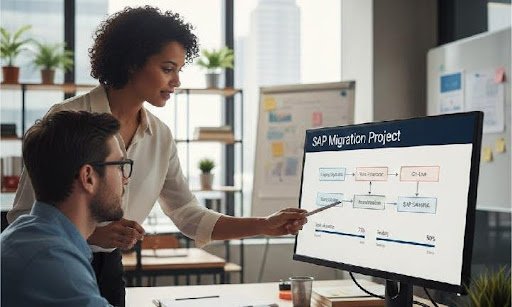
Data-First Migration: Aligning SAP Modernization with Enterprise Data Strategies
Enterprise modernization programs increasingly recognize that ERP transformation is inseparable from the enterprise data agenda. In large organizations running complex SAP landscapes, migration decisions are no longer evaluated solely through application architecture lenses; they are assessed against enterprise data strategy maturity, governance readiness, and long-term analytical ambitions. This shift reframes SAP data migration from a technical conversion activity into a strategic sequencing exercise that determines how quickly the organization can harmonize data models, retire redundant repositories, and enable consistent decision intelligence. The Boards and CIO councils are now examining whether programs for migration help build an integrated data backbone or simply replicate fragmentation from the past using a more modern platform. The most important economic issue is therefore not merely about the feasibility of migration, but also whether modernization creates lasting data aligning across business units and geographical regions.
Data-First Migration: Reframing Modernization Priorities
A data-driven perspective requires leadership teams to rethink the conventional ERP scheduling assumptions. The traditional migration roadmaps focused on stability of the application before considering harmonization of data. In reality, this frequently perpetuated inconsistencies from the core of the system, resulting in an technically advanced, but semantically fragmented system. Proficient program administrators are increasingly reversing this logic, arguing the data model convergence ought to be preceded or at the very least evolve alongside system conversion.
This reframing brings governance implications. Ownership models for data master data stewardship and transparency of lineage data must be resolved quickly, and not deferred until post-go-live optimization stages. Otherwise, the migration process becomes an exercise in transferring unsolved data conflicts into a rigid structure, where remediation is more expensive. Furthermore, businesses find that data structures that are aligned can accelerate downstream initiatives like predictive planning and the modernization of regulatory reports. The conclusion is that focusing on data alignment when moving data is less about pure technicality as much as it is about stopping structural changes which would otherwise diminish the value of modernization in terms of strategic benefits.
Governance Alignment Between Data and ERP Programs
Enterprise-scale programs show ERP as well as data-related initiatives usually run under separate governance streams, each designed to meet different success indicators. ERP teams usually concentrate on continuity of processes and integrity of transactions, while data governance councils are focused on the quality of their work, taxonomy consistency and reuse. Inconsistencies between these areas cause tension, especially when migration timeframes force groups to compromise standardization choices.
Experienced transformation leaders reduce this by creating an integrated governance forum where architecture, data, as well as business process trade-offs can be adjudicated in a collective manner. These forums shift the conversation away from purely technical discussions to enterprise-wide risks and value issues. In particular, allowing temporary data exceptions can speed cutting-over, but it could also undermine the consistency of cross-entity reporting for a long time. In contrast, strict uniformity could prolong the timeframe of projects but also reduce the burden of reconciliation over time.
The real-world application lies in the fact that integrating governance isn’t an administrative formality, but is the process by that enterprises manage speed control, speed, and data scaling. In the event that ERP as well as data-related agendas align at the level of governance and decisions about migration are more unified and less vulnerable to the volatility of late-stage scope.
Execution Realities: Data Complexity and Integration Trade-offs
Though strategy discussions usually focus on an idealized data landscape, the actual implementation uncovers the deep-rooted complexity that has been shaped by decades of acquisitions, regional variations in processes, and custom-designed integrations. Data-first migration strategies must deal with the conflict between the idealistic architecture and pragmatic operational thinking. Eliminating any legacy inconsistencies prior to the migration process could be desirable on paper, but not feasible within the real-world transformation window.
Practitioners deal with this by implementing the use of phased rationalization models. The core supply chain and financial master-data domains usually targeted for strict harmonization and peripheral data may be subject to controlled coexistence in accordance with specified sunset times. Integration architecture is also an important factor. Older middleware patterns may speed up or limit data alignment based upon their flexibility and the degree of governance discipline.
These trade-offs require an enlightened approach to program economics. The excessive cleansing of data can delay realizing business value, however inadequate rationalization can lead to the hidden costs of reconciliation. It is important to remember that a successful data-first migration isn’t an absolute goal to be perfect, but an equilibrated compromise between the ambitions of data integrity and the need for operational continuity.
Sustaining Value Through Data-Centric Operating Models
The success over the long term of a data-aligned transition depends more on the cutting-over date in the long run, and much more upon the operational model that controls the data’s evolution following the cutover. Businesses that consider migration to be an event that is only once harmonization will tend to regress when the new models for business, regulations and acquisitions bring new data heterogeneity. Therefore, the most successful enterprises implement continuous data governance as part of the ERP operation model.
This entails formalizing stewardship responsibilities as well as integrating KPIs for data quality into operational scorecards and integrating change management processes with assessments of data impact. In time, these processes transform the ERP central system into a live data platform instead of an inactive transactional system. The operating model should also be able to be aware of emerging patterns of integration using AI-driven analytics platforms, analytics platforms tools for planning and other ecosystem partners. The conclusion drawn is that the migration process creates the foundation for structural change, however the value of data is realized only when organizations implement data discipline as a permanent capability, not merely a project artifact.
In the end, integrating SAP modernization with data strategy for enterprise requires reconsidering the notion of migration as a governance-driven change, not merely a technical upgrade. Data-first sequencing integrated governance, sensible execution trade-offs and continuous operating discipline determine whether modernization will provide long-lasting analytical coherence, or simply modernizes fragmentation from the past. Companies that recognize these dynamical aspects consider migration as a gradual development guided by clearly defined values for data as well as risk-based thresholds. When supported by disciplined program architecture and advisory oversight from a credible SAP integration partner, modernization becomes an enabler of enterprise-wide data convergence, strengthening both decision consistency and long-term scalability without compromising operational resilience.
Also visit Digital Global Times for more quality informative content.
