
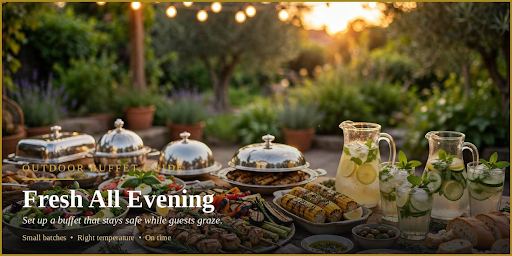
Setting Up an Outdoor Buffet Without Leaving Food Exposed All Evening
A warm evening, family and friends moving between the kitchen and the patio, and a buffet table full of food. Everyone grazes for hours, and the food sits out the whole time. It looks fine, but warm weather is exactly when bacteria grow fastest, and a dish that sat out too long can make people sick.
This guide starts with the setup, then covers the food rules: small batches, holding equipment, insects, and leftovers. Hang the lights overhead so the table stays clear for serving, and keep a separate task light over the food so serving is easy after dark. Christmas light installation cost in Miami, FL varies with the size of the display, so get a quote before you book someone to hang the lights.
Set Up the Space First: Shade, Layout, and Light
Set the dining area up before the food comes out. Put the food table in the shade, away from the grill smoke and the seating, so guests do not crowd the food while they eat. Hang string lights above the dining area so the table stays clear for serving, and keep a separate task light over the food table itself.
A shaded table stays cooler, and food kept out of the sun stays safe for longer. Keep the food table away from the seating so guests do not crowd around it while they eat. When the table is set before the food comes out, the host spends the evening with the guests instead of fixing the setup.
The Two-Hour Rule: How Long Food Can Sit Out
Food safety experts say that bacteria can double in as little as 20 minutes in the range that they refer to as the “danger zone,” which is between 40°F and 140°F. Once perishable food leaves the fridge, you have two hours before it is no longer safe to eat. On a day hotter than 90°F, that window shrinks to a single hour. Count every minute toward those two hours: the prep work, the wait before serving, and the time on the table all use up the same window.
What Counts as Perishable Food
Foods such as meat, poultry, seafood, dairy products, and eggs, as well as cut fruit, and cooked or prepared foods are all considered perishable. Foods such as bread or whole fruit are not perishable and can be left out. Dishes that contain meat, poultry, or eggs are also perishable and need to be treated that way.
Serve in Small Batches: Refill Often, Waste Less
The easiest way to keep food safe on a buffet is to have it prepared in small batches. The food that is on the buffet gets replaced often so it doesn’t get dry or stale, and the food that is being prepared and kept back stays cold.
- Keep Half of Each Food in the Fridge or Cooler
- Refill dishes that are empty. Don’t top off food that has been sitting out.
- Use a serving spoon and have it in the food so people do not touch the food.
- Use a clean serving spoon each time you refill a dish.
Small batches of food mean less waste. When the party ends, only the last small batch is left to pack away, not a full tray that sat out all evening.
Holding Equipment That Keeps Hot Food Hot and Cold Food Cold
Hot food needs to stay at 140°F or above. One way to do this is by using a slow cooker on the warm setting. A chafing dish with a fuel burner also works. To check the temperature, use a food thermometer. Food can be dangerous and in the temperature danger zone even if it feels warm to the touch.
To keep cold food cold, use a container with ice, and place the cold food inside of it. Dishes also need to be pre-chilled. Insulated carriers keep dishes at the right temperature as they go in and out of the kitchen.
Keep Insects Off the Food: Covers, Fans, and Timing
When food is left out for an extended period of time, cover it. A mesh dome does both jobs at once: it keeps the flies off and still lets everyone see the food. Use a fan to keep flies from landing on food. As guests take food, cover it again to help control how much food is left out.
Citronella candles around the seating area can help keep insects away, but not on the food. Foods should be put out as guests arrive. Cover food again as the serving slows down. Food should not be left out to attract insects. Keep sweet dishes covered most of all, because sugar draws insects faster than anything else on the table.
Plan the Evening Around the Clock: A Simple Serving Timeline
A timeline keeps the 2-hour rule from becoming a guessing game. Put the food out when guests arrive, not an hour before. Plan one refresh halfway through the evening. Set a phone alarm for the two-hour mark so the leftovers go in on time. When it rings, pack up what is left, even if guests are still grazing. Food that goes in on time can be served again tomorrow.
When Leftovers Go Back Inside: Beat the Two-Hour Clock
Start the clock when the food goes out, and bring the leftovers inside within 2 hours. If the air is above 90°F, bring them in within 1 hour. Pack leftovers into shallow containers so they cool fast, and get them into the fridge right away. Write the time on a sticky note on the fridge so nobody has to guess when the food went out.
Throw out perishable food that sat out longer than the limit, even if it looks and smells fine. Food that looks safe can still carry bacteria, and the USDA rule is plain: when in doubt, throw it out. Reheat leftovers to 165°F before serving them again.
Conclusion
A buffet stays safe when the space is set up first, the food goes out in small batches, and everything is held hot or cold. It is not luck that keeps the food safe. It is the setup, the batches, and the clock. The guests remember the evening, not the food safety rules, and that is how it should be. Set the table in the shade, keep the batches small, cover the dishes, and bring the leftovers in on time. The party lasts all evening. The food does not have to.
